
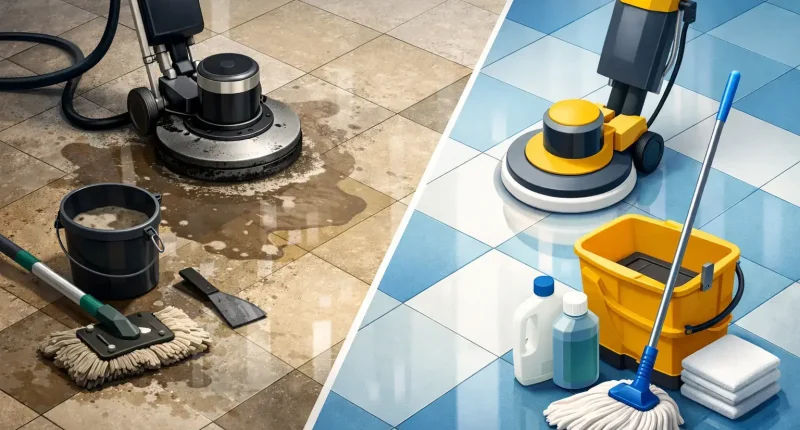
A VCT floor can look worn long before the tile itself needs to be replaced.
Gray traffic lanes, black scuff marks, dull patches near entrances, uneven shine, and a finish that still looks dirty after routine cleaning are often signs that the protective floor finish has become worn, scratched, or loaded with soil.
For Tampa Bay businesses and managed properties, professional VCT floor care is about more than appearance. The right maintenance process can help keep floors looking cleaner, more consistent, and easier to maintain while supporting the useful life of the flooring underneath.
At HydroGlow Cleaning and Floor Care, VCT service begins with evaluating the condition of the tile, the existing finish, traffic patterns, previous maintenance, and whether the floor needs routine cleaning, a scrub and recoat, or a complete strip and refinish.
What VCT Floor Stripping and Waxing Actually Does
VCT, or vinyl composition tile, is commonly used in commercial buildings because it is durable, practical, and serviceable.
You may find VCT in:
- Medical offices
- Retail stores
- Churches
- Schools
- Apartment common areas
- Restaurants
- Offices
- Commercial buildings
- Community facilities
The appearance of VCT depends heavily on the protective floor finish applied over the tile.
That finish takes much of the daily wear from:
- Foot traffic
- Dirt and grit
- Rolling carts
- Shoe scuffs
- Spills
- Moisture
- Routine cleaning
Over time, the finish can become scratched, dull, uneven, yellowed, or loaded with embedded soil.
When that happens, another coat of finish alone may not solve the problem.
Signs Your VCT Floor Needs More Than Routine Cleaning
Routine mopping and maintenance can help preserve a floor finish, but they cannot correct a finish that has already broken down.
Common warning signs include:
- Dark traffic lanes
- Heavy scuffing
- Uneven shine
- Dull or gray areas
- Yellowed finish
- Sticky or dirty-looking buildup
- Peeling or flaking
- Areas that still look dirty after cleaning
- Heavy wear around entrances and hallways
A floor may also show a noticeable difference between low-traffic edges and heavily used open areas.
If the perimeter still looks glossy while the center of the floor looks flat or gray, the finish is likely wearing unevenly.
Why Traffic Lanes Develop
VCT floors often wear fastest where people and equipment repeatedly travel.
Common high-traffic areas include:
- Entrances
- Hallways
- Checkout lanes
- Break rooms
- Reception areas
- Service counters
- Routes between workstations
Dry soil and grit can become embedded in the finish and act like an abrasive under shoes and rolling equipment.
Over time, this can create darkened or dull traffic patterns that ordinary mopping does not correct.
What a Full VCT Strip and Refinish Involves
A full strip and refinish is intended to remove worn or failed floor finish and rebuild the protective system from a properly prepared surface.
A professional process may include:
- Evaluating the existing finish
- Applying an appropriate stripping solution
- Controlled agitation
- Detailed edge and corner work
- Removing old finish and residue
- Thorough rinsing
- Allowing the floor to dry
- Applying multiple thin coats of commercial floor finish
The exact process depends on the condition of the floor and the type of finish already present.
Why Proper Stripping Matters
Stripping is not simply applying chemical and running a machine over the floor.
Improper technique can leave behind:
- Finish residue
- Uneven areas
- Edge buildup
- Chemical residue
- Inconsistent results
If old finish or residue remains on the surface, new finish may not look or perform evenly.
Detailed work around:
- Baseboards
- Corners
- Doorways
- Fixtures
- Transitions
- Edges
is especially important because these areas often reveal rushed work.
Proper Rinsing and Drying Are Critical
After stripping, the floor must be thoroughly rinsed and properly prepared before new finish is applied.
Residual stripping solution can interfere with the appearance and performance of the new finish.
The surface also needs appropriate drying time.
Rushing from stripping into finish application can contribute to:
- Uneven gloss
- Cloudiness
- Poor adhesion
- Premature wear
A professional process should allow enough time for each stage rather than treating the project as one continuous application.
“Waxing” Usually Means Applying Floor Finish
The term “waxing” is commonly used for VCT maintenance, but modern commercial floors usually receive a manufactured floor finish rather than traditional wax.
The purpose of the finish is to:
- Protect the tile surface
- Create a cleaner, more uniform appearance
- Provide sacrificial wear layers
- Make ongoing maintenance more manageable
The goal is not necessarily maximum gloss.
The appropriate finish level depends on the property, traffic, and maintenance expectations.
Multiple Thin Coats Are Better Than One Heavy Coat
Commercial floor finish is usually built through multiple thin, even applications.
Heavy coats may dry unevenly and can create inconsistent results.
Allowing proper drying time between coats helps create a smoother, more uniform finish.
The number of coats depends on:
- Floor condition
- Product used
- Desired appearance
- Traffic level
- Facility needs
When a Full Strip Is Not Necessary
Not every dull VCT floor needs complete stripping.
If the existing finish is still stable and the primary problems are:
- Light scratching
- Minor scuffing
- Reduced gloss
- Surface soil
a scrub and recoat may be a better option.
This process removes surface soil and lightly worn finish, then adds new protective coats without taking the floor all the way back to bare tile.
Strip and Refinish vs. Scrub and Recoat
The two services serve different purposes.
Scrub and recoat may be appropriate when:
- Existing finish is still sound
- Wear is mostly superficial
- The floor is not heavily yellowed
- There is no major peeling or finish failure
Full stripping and refinishing may be more appropriate when:
- Finish is heavily worn
- Soil is embedded in older coatings
- The floor is yellowed
- Layers are uneven
- Finish is peeling
- Traffic lanes are severe
- Recoating would trap the problem underneath
The least disruptive service is not always the right one, and the most extensive service is not always necessary.
A professional floor assessment helps determine which option makes sense.
How Often Should VCT Be Stripped and Waxed?
There is no single schedule that fits every VCT floor.
The right timing depends on:
- Traffic volume
- Cleaning frequency
- Entrance matting
- Floor finish used
- Maintenance methods
- Type of facility
- Operating hours
- Rolling equipment
- Spill exposure
A busy retail floor may need attention more often than a lightly used professional office.
Rather than following a fixed calendar, it is better to evaluate the actual condition of the finish.
Maintaining VCT Between Major Services
Routine maintenance can help extend the life of the finish.
Helpful practices include:
- Dust mop or vacuum regularly
- Remove grit before it is walked into the finish
- Use clean entrance mats
- Clean spills promptly
- Use a neutral cleaner designed for finished floors
- Follow proper dilution instructions
- Avoid harsh chemicals
- Maintain high-traffic areas more frequently
Too much cleaning product can leave residue and make the floor look dull.
Harsh chemicals can also shorten the useful life of the finish.
Burnishing and Interim Maintenance
Some VCT floors may benefit from periodic burnishing or machine maintenance between major restoration services.
This can help improve the appearance of the existing finish when it is still in serviceable condition.
The appropriate schedule depends on:
- Traffic
- Finish type
- Desired appearance
- Facility use
- Maintenance staffing
Not every property needs the same maintenance program.
Plan Around Business Operations
VCT stripping and refinishing requires drying time and controlled access.
For commercial properties, scheduling may need to account for:
- Business hours
- Customer traffic
- Employee access
- Furniture movement
- Tenant schedules
- Medical or facility operations
Work may be scheduled:
- After hours
- In phases
- During low-traffic periods
- Around the operational needs of the property
The floor should not be returned to normal traffic until the finish has had appropriate drying and curing time for the product and conditions.
Professional VCT Stripping and Waxing in Tampa Bay
A dull VCT floor does not automatically need replacement.
In many cases, professional cleaning, scrub-and-recoat service, or a complete strip and refinish can significantly improve the appearance and maintainability of the floor.
HydroGlow Cleaning and Floor Care provides professional VCT stripping and waxing for commercial properties throughout Tampa Bay and surrounding service areas.
If your VCT floor has dark traffic lanes, heavy scuffing, yellowed finish, uneven shine, or no longer looks clean after routine maintenance, contact HydroGlow Cleaning and Floor Care to request an evaluation or estimate.